

For most people, estate planning feels like something to finish. You meet with an attorney, sign a stack of documents, put the binder in a drawer, and check it off the list. That step matters, and if you've done it, you're already ahead of many families.
But documents alone rarely accomplish what people actually want from an estate plan. What most of us really want is both simpler and harder: to know our family will be cared for, that our wishes will be honored, and that the people we love won't be left confused, overwhelmed, or in conflict when something happens.
Picture a surviving spouse sitting at the kitchen table after a loss. She knows there is a trust, but which accounts were actually placed in it? Who is the CPA? Where is the life insurance policy? What bills are on autopay? What did her husband want for his care if he became seriously ill? The documents may be perfectly drafted, and she can still be left guessing.
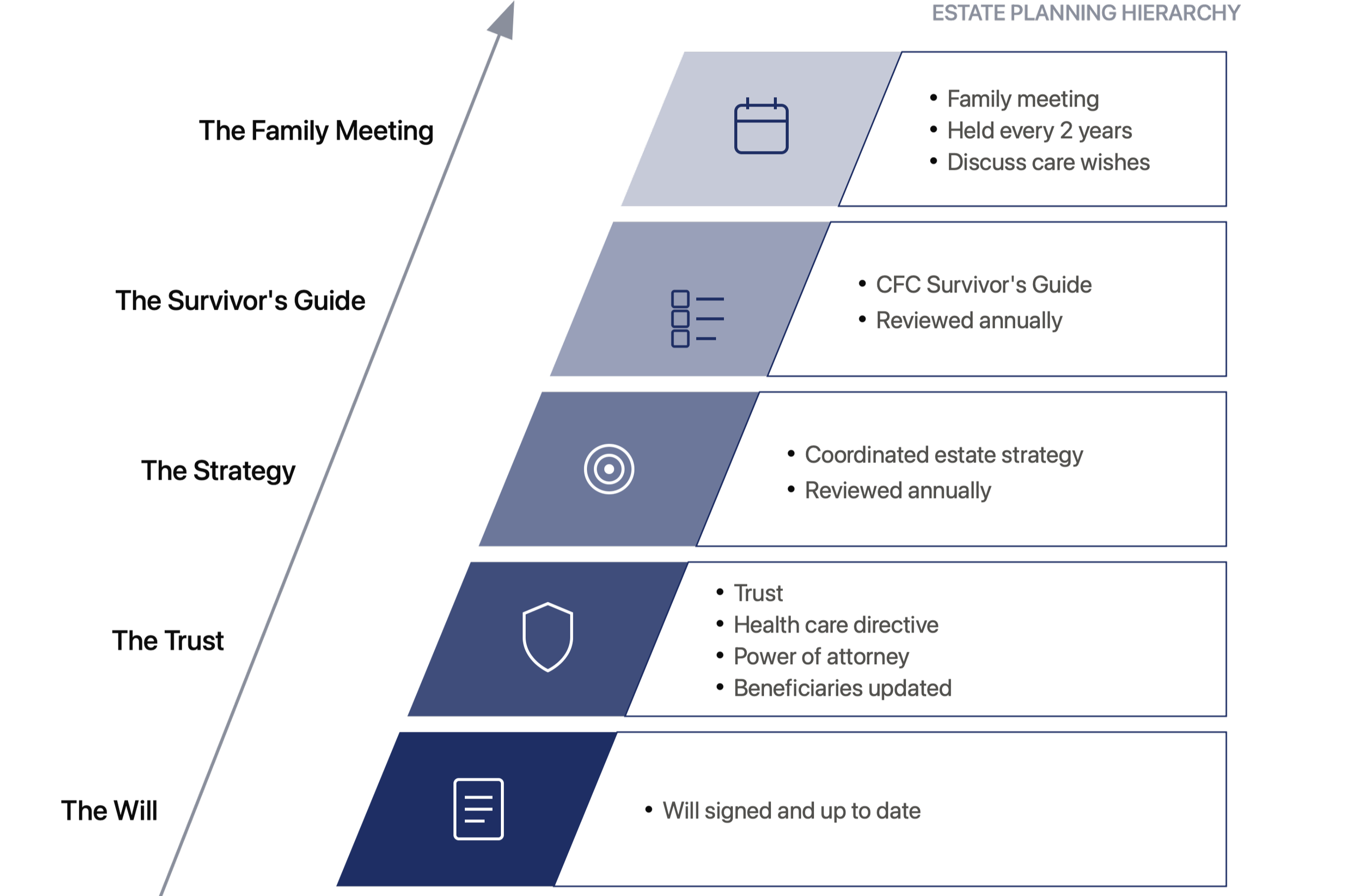
That's why we think about estate planning as a hierarchy. Each level builds on the one below it, moving from the essential legal foundation toward something more complete: a plan your family understands, can carry out, and has talked through together.
Level 1: The Will
The will is the foundation of an estate plan. It states who receives your assets, names an executor to settle your estate, and, for parents of young children, names guardians. Without one, state law makes those decisions for you, and the result may look very different from what you would have chosen.
The most basic standard is a will that is signed and up to date. A will drafted twenty years ago may still name an ex-spouse as executor, leave out grandchildren who have since been born, or appoint a guardian who is no longer in a position to serve. An outdated will can create nearly as many problems as having no will at all.
A will also has important limitations. It generally must pass through probate, a court process that can be slow, costly, and public. It doesn't control assets that pass by beneficiary designation, such as retirement accounts and life insurance. And it doesn't help if you are alive but unable to make financial or medical decisions for yourself.
That's where the next level comes in.
Level 2: The Trust and Essential Documents
The second level fills in many of the gaps a will leaves behind. A trust, most commonly a revocable living trust, can allow assets to pass to your heirs privately and often without probate. It also names a successor trustee who can step in and manage assets if you become incapacitated.
But there is an important caveat: a trust only works for assets that have actually been properly transferred or otherwise coordinated with it. An unfunded or improperly funded trust can leave a significant gap in an otherwise well-drafted plan.
Other documents are equally important. A health care directive names the person who will make medical decisions on your behalf and documents your wishes about treatment. A power of attorney does the same for financial and legal matters, allowing someone you trust to step in if you cannot manage those responsibilities yourself.
Then there are beneficiary designations. Retirement accounts, annuities, and life insurance generally pass directly to the people named on the beneficiary form, regardless of what your will or trust says. A form that still lists a former spouse, or a beneficiary who has passed away, can quietly undermine the rest of your plan.
Many families stop here, and that's a meaningful accomplishment. But notice that everything at this level is still primarily about documents. The next level asks a different question: Do all of these pieces actually work together?
Level 3: The Strategy
Documents answer the question, "Who gets what?" A strategy answers the bigger question: "How does all of this fit together, and is it still the right plan?"
A coordinated estate strategy looks at the whole picture. Are account titles and beneficiary designations consistent with the trust? Are there tax considerations that affect how and when assets should pass? Would it be better for a child to inherit outright or through a trust over time? Are there charitable goals to incorporate? Is there enough liquidity to cover expenses without forcing the sale of something the family wants to keep? Are the people named as executor and trustee still the right people for those responsibilities?
These questions often require your financial advisor, estate attorney, and CPA to work from the same information rather than in separate silos. The goal isn't simply to have good individual documents. The goal is to make sure the pieces work together.
And the strategy shouldn't be treated as permanent. We believe it should be reviewed at least annually. Marriages, divorces, births, deaths, moves, the sale of a business, significant changes in wealth, and changes in tax law can all affect what the right plan looks like. An annual review helps catch that drift before it becomes a problem.
But even a well-coordinated strategy leaves one important question unanswered: What happens when your family needs to use the plan?
Level 4: The Survivor's Guide
Even the best estate plan can leave a practical gap. The people you leave behind still have to carry it out, often while grieving.
In the days and weeks after a death, families face a long list of practical questions. Who do we call first? Where are the original documents? Which accounts exist, and at which institutions? What bills are on autopay? Where are the insurance policies? Who is the CPA? Who is the financial advisor? How do we access the important online accounts?
A Survivor's Guide answers those questions before they become urgent.
The CFC Survivor's Guide brings key information together in one place: important contacts, where accounts and documents are located, and a practical roadmap for the first steps your loved ones may need to take. Instead of searching through drawers, inboxes, and old emails, your family has a clear starting point.
Like the strategy itself, the Survivor's Guide should be reviewed regularly. Accounts get opened and closed, professionals change, and contact information becomes outdated. A guide is only useful if it reflects your life as it exists today.
But there is still one level above having a well-organized plan.
Your family needs to understand it.
Level 5: The Family Meeting
At the top of the hierarchy is the step most families skip, and often the one that matters most: sitting down together and talking.
The best documents in the world can still create hurt or conflict if they come as a surprise. If one child is named trustee and another isn't, if assets are being divided unequally for good reasons, or if a significant gift is going to charity, those decisions can land very differently when your family hears the reasoning directly from you than when they discover it in a document after you're gone.
The family meeting isn't about defending every decision. It's about providing context.
It is also the right place to discuss care wishes. Where would you want to live as you age? Who do you hope will help? What matters most to you about your quality of life? What would you want if you could no longer make decisions for yourself?
These are difficult conversations, but having them while everyone is healthy and calm is far better than leaving your family to guess during a crisis.
A family meeting is also an opportunity to introduce your family to the professionals who will help them. When your children already know your financial advisor, attorney, and CPA, the first conversation with them doesn't have to happen at the worst possible time.
We recommend having a family meeting every two years. Families change. Children become adults. Relationships evolve. Financial circumstances change. A recurring conversation turns estate planning from a one-time announcement into an ongoing process.
And it doesn't require sharing every financial detail. You decide how much information is appropriate for your family. The goal isn't disclosure for its own sake. The goal is understanding.
Why the Progression Matters
The arrow in the hierarchy points upward for a reason. Each level builds on the one below it.
You can't have a meaningful family conversation about a plan that doesn't exist. A Survivor's Guide is only useful if the documents and strategy behind it are accurate. And a sophisticated estate strategy doesn't accomplish its purpose if the people responsible for carrying it out don't understand it.
As you move up the hierarchy, the purpose of the plan changes. The lower levels are primarily about protecting your assets and establishing legal authority. The upper levels are about protecting something just as important: your family's clarity, confidence, and relationships with one another.
A complete estate plan does both.
Where Are You on the Hierarchy?
It's worth taking an honest look at where you stand today. Is your will signed and current? Is your trust properly funded? Are your health care directive, power of attorney, and beneficiary designations up to date? Has someone reviewed how all the pieces work together within the last year? Would your family know where to start if something happened tomorrow? And perhaps most importantly, have you talked with them about your wishes, including how you want to be cared for?
Most families find they are somewhere in the middle. That's perfectly normal. The point isn't to reach the top overnight. It's to keep moving upward, one level at a time.
Estate planning isn't really about creating a binder. It's about creating a plan your family can understand, access, and carry out when they need it most. And ultimately, it's about giving the people you love something more valuable than paperwork:
Clarity.
If you'd like help figuring out your next step — whether that's updating a will, coordinating your estate strategy, building a Survivor's Guide, or planning a family meeting — we'd be glad to have that conversation with you.
This article is for informational purposes only and is not legal or tax advice. Please consult a qualified estate planning attorney and tax professional regarding your specific situation.